October 2026 • 8 min read
Portugal has two groups of islands in the Atlantic. The Azores are nine volcanic islands about 1,400 km (870 miles) west of Lisbon, roughly a third of the way to Boston, with crater lakes, hot springs, whales and green pasture. Madeira is a single large island (plus Porto Santo) about 1,000 km southwest of Lisbon, warmer, drier and more built up, with levada walks and a famous wine.
If you heard about "the island off Portugal that looks like Hawaii", that is the Azores, specifically São Miguel. If you heard about "the island of eternal spring" with the New Year fireworks, that is Madeira. Both are Portugal, both use the euro, and both are easier to reach from the US East Coast than most Americans expect.
The Two Archipelagos, Side by Side
The confusion is understandable. Both archipelagos are autonomous regions of Portugal, both were settled by the Portuguese in the 15th century, both are volcanic and both market themselves on green landscapes and mild weather. They are nevertheless 1,000 km apart and quite different places.
The Azores are nine inhabited islands spread across 600 km of ocean in three groups: São Miguel and Santa Maria in the east, Terceira, Graciosa, São Jorge, Pico and Faial in the centre, Flores and Corvo in the west. Together they cover 2,351 km² and are home to about 236,000 people, well over half of them on São Miguel. The highest point, Mount Pico, is also the highest mountain in Portugal at 2,351 m. The islands sit on the junction of the North American, Eurasian and African plates, which is why they have active geothermal valleys, hot springs and a volcano, Capelinhos on Faial, that last erupted in 1957. The capital of the largest island is Ponta Delgada, and the time zone is one hour behind Lisbon.

Madeira is one main island of 741 km² with about 250,000 people, plus the small, sandy island of Porto Santo and two uninhabited groups. Funchal, the capital, is a real city with a cruise port, a cable car and a seafront of resort hotels. The island is steep and dramatic, with sea cliffs, 1,800 m peaks, a UNESCO-listed laurel forest and more than 2,000 km of levadas, the irrigation channels whose maintenance paths became one of Europe's great walking networks. Its volcanoes are extinct, so there are no hot springs.
Portugal also has a handful of small islands close to the mainland coast, the Berlengas off Peniche being the best known, but when someone talks about "the islands off Portugal" as a holiday destination, they mean the Azores or Madeira.

Which One Were You Thinking Of?
A few clues to match the island you heard about to the right name.
If it was described as the Hawaii of the Atlantic, the Hawaii of Europe or the Hawaii of the East Coast, with twin blue and green crater lakes, a hot spring in a botanical garden and whales, that is the Azores, and the island in the photos is almost always São Miguel. We have written a separate piece on how fair the Hawaii comparison is; the short version is that the volcanoes, the greenery and the ocean match, the temperatures and the beaches do not.

If it was described as the island of eternal spring, with a cable car above a city, wicker toboggans, a wine that shares its name and the biggest New Year's Eve fireworks in Europe, that is Madeira.
If a friend flew there nonstop from Boston in about five hours and rented a car to drive around a single island of lakes and cows, that is São Miguel in the Azores. If they connected through Lisbon and stayed at a cliff-top resort with a pool, it was probably Madeira.
If they talked about the Irish-looking countryside, stone walls, cattle in every field and forty shades of green, that is the Azores too. The resemblance to the west of Ireland is real, down to the weather that changes four times a day, with the difference that the fields in the Azores slope down to black lava coastlines and up to volcanic craters.
✈️ AZORES PACKAGES FROM THE US
Flights, hotel and rental car on São Miguel or across two or three islands, planned by a team based in Ponta Delgada.
See Azores packages →Where Exactly Are They?
Look at a map of the North Atlantic. Lisbon sits on the western edge of Europe. Go 1,000 km southwest, level with Casablanca, and you reach Madeira. Go 1,400 km due west from Lisbon, into the middle of the ocean, and you reach the Azores. From the Azores it is a further 3,900 km or so to Boston, which is why the islands were a refuelling stop for the first transatlantic flights and why the US Air Force still shares the airfield at Lajes on Terceira.

For a traveller the practical consequence is flight time. Boston to Ponta Delgada is about five hours nonstop, shorter than Boston to Los Angeles. Lisbon to Ponta Delgada is about 2h20, Lisbon to Funchal about 1h40, and Funchal to Ponta Delgada about 1h45, which makes it easy to put both archipelagos, or either of them plus mainland Portugal, into one trip.
Getting There From the United States and Canada
The Azores are the easier of the two. Azores Airlines flies nonstop from Boston to Ponta Delgada year-round, several days a week, in roughly five hours, and serves New York JFK, Toronto and Montreal, with some routes seasonal. The large Azorean communities in Massachusetts, Rhode Island and Ontario are the reason these routes exist, and they keep fares reasonable outside July and August.
Madeira has no scheduled nonstop flights from the United States. You connect in Lisbon (TAP and others) or in Ponta Delgada with Azores Airlines, and the journey is a travel day of ten hours or more each way. From Canada, Azores Airlines has operated seasonal Toronto to Funchal flights in some years; check the current schedule.
Once on the islands, rent a car. Public transport exists in Funchal and Ponta Delgada but the places you came for, the crater lakes, the levadas, the viewpoints, are not on bus routes.
Which One Should You Visit?
Go to the Azores if you want nature first: hot springs, crater lakes, whale watching with resident sperm whales, hiking without crowds, and small hotels rather than resorts. Go if you are flying from the US East Coast and want a nonstop. Go if the idea of island-hopping between nine different places appeals, and accept that you will see rain somewhere most days outside high summer.
Go to Madeira if you want warmer, drier weather between November and March, a lively city base with restaurants and nightlife, a resort hotel with a pool, a different levada walk every day without changing hotel, or a golden sand beach (on Porto Santo, a ferry away). Go if you are already in Lisbon and want the shorter hop.
Go to both if you have twelve days or more: five or six nights in Madeira for the levadas and the warmer sea, then the 1h45 flight to São Miguel for lakes, hot springs and whales. We have a full Azores vs Madeira comparison with weather, costs and crowds by the numbers if you want to go deeper before deciding.
MADEIRA + SÃO MIGUEL IN ONE TRIP
Both archipelagos, with flights, hotels, rental cars and the connection between them included.
See the Madeira + São Miguel package →A First-Timer's Week in the Azores
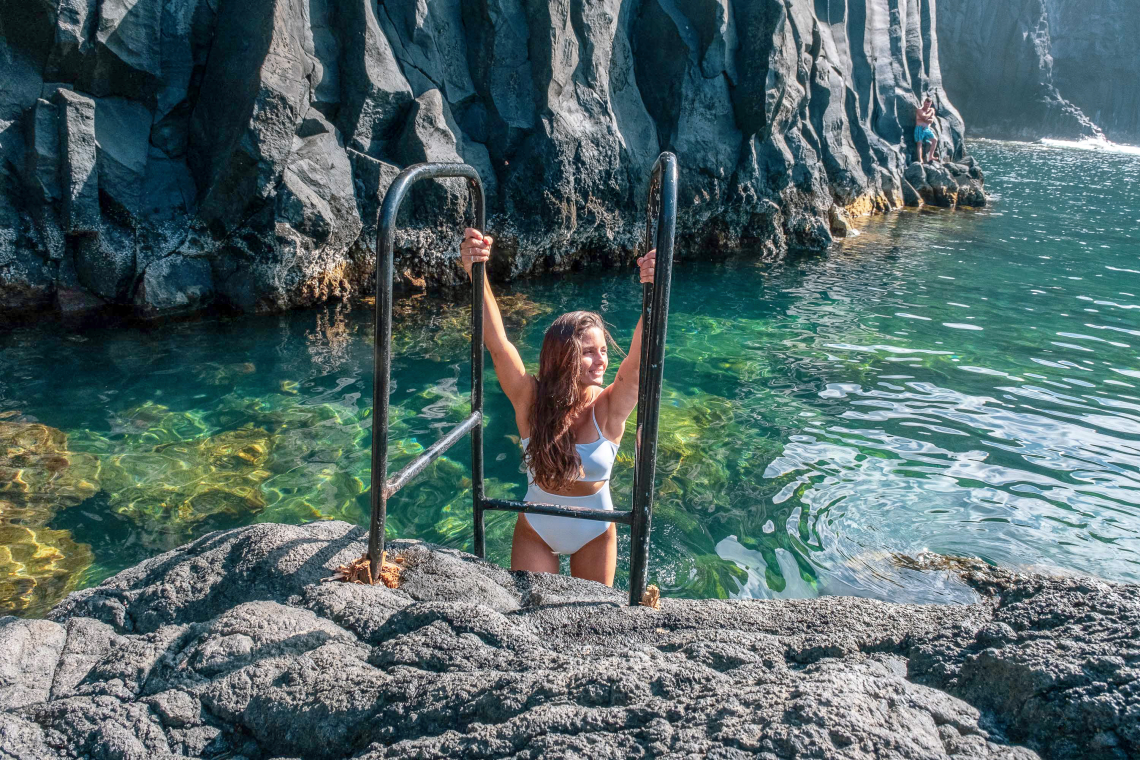
Most first visits are São Miguel only, and a week is right. Two nights in Ponta Delgada to walk the town, eat well and take a whale watching trip from the marina. Two or three nights in Furnas for the boiling caldeiras, the cozido lunch cooked in the ground, the Terra Nostra garden and its iron-rich pool, and the tea plantations on the north coast. Two nights in the west for the Sete Cidades twin lakes from the Vista do Rei viewpoint, the natural pools and sunset at Mosteiros, and Caldeira Velha's warm waterfall on the way back. One car, two or three hotels, no internal flights.
With ten days, add Terceira (45 minutes by air) for the UNESCO town of Angra do Heroísmo and the Algar do Carvão lava tube, or Pico and Faial for the mountain, the vineyards and the whaling-town atmosphere of Horta. Our packages bundle the flights, hotels and cars for any of these combinations.
Islands Off Portugal: FAQ
What are the islands off the coast of Portugal called?
The Azores, nine islands about 1,400 km west of Lisbon in the mid-Atlantic, and Madeira, one main island plus Porto Santo about 1,000 km southwest of Lisbon. Both are autonomous regions of Portugal.
Which Portuguese island is like Hawaii?
The Azores, and São Miguel in particular: volcanic crater lakes, hot springs, green slopes and whales. The comparison is about landscape rather than climate; the Azores are temperate, with a sea of 16°C to 23°C and air rarely above 26°C.
Are the Azores part of Portugal?
Yes. The Azores have been Portuguese since settlement began in 1439 and have been an autonomous region with their own government since 1976. The currency is the euro and the language is Portuguese; English is widely spoken in tourism.
How far are the Azores from the United States?
About 3,900 km (2,400 miles) from Boston. Azores Airlines flies the route nonstop in about five hours.
Are the Azores or Madeira closer to Portugal?
Madeira, at about 1,000 km from Lisbon (a 1h40 flight), against 1,400 km for the Azores (about 2h20).
Which is better to visit, the Azores or Madeira?
It depends on what you want. The Azores for nature, hot springs, whales, quiet trails and a nonstop from Boston; Madeira for warmer winters, a city base, resort hotels and levada walks. Our full comparison covers weather, costs and crowds in detail.
Do you need a car in the Azores or Madeira?
Yes on both, unless you stay in the capital and book tours. The lakes, viewpoints and trailheads are not served by public transport.
Can Americans visit the Azores without a visa?
US citizens can visit Portugal, including the Azores and Madeira, visa-free for up to 90 days in any 180-day period as part of the Schengen area. Check current entry requirements before you travel, as EU border procedures change.
Plan it your way
Custom Your Trip
Tell our local travel advisors which islands, dates and experiences you want and we build the itinerary around you.
Start your custom trip →Limited time
Azores Packages On Sale
Flights, hotels and rental car bundled at reduced prices. See every package currently on sale and book while it lasts.
Book now →