10 August 2026 • 8 min read
Most people visit Corvo for a single day and leave on the afternoon boat. That is enough to see the caldera in daylight. It is not enough to see it the way it actually looks: at dawn, when the crater fills with mist, or at dusk, after everyone else has gone.
This guide covers the essential places to see on Corvo, and the specific details that make each one worth visiting on its own terms.
1. The Caldeirão
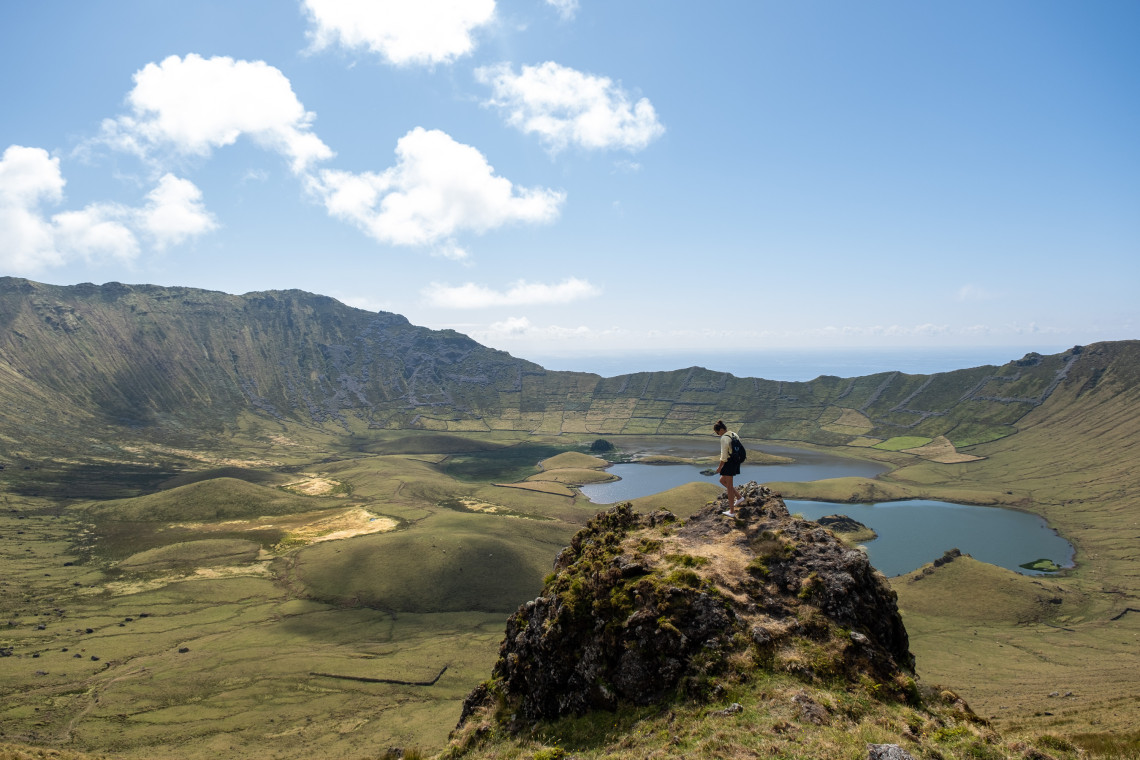
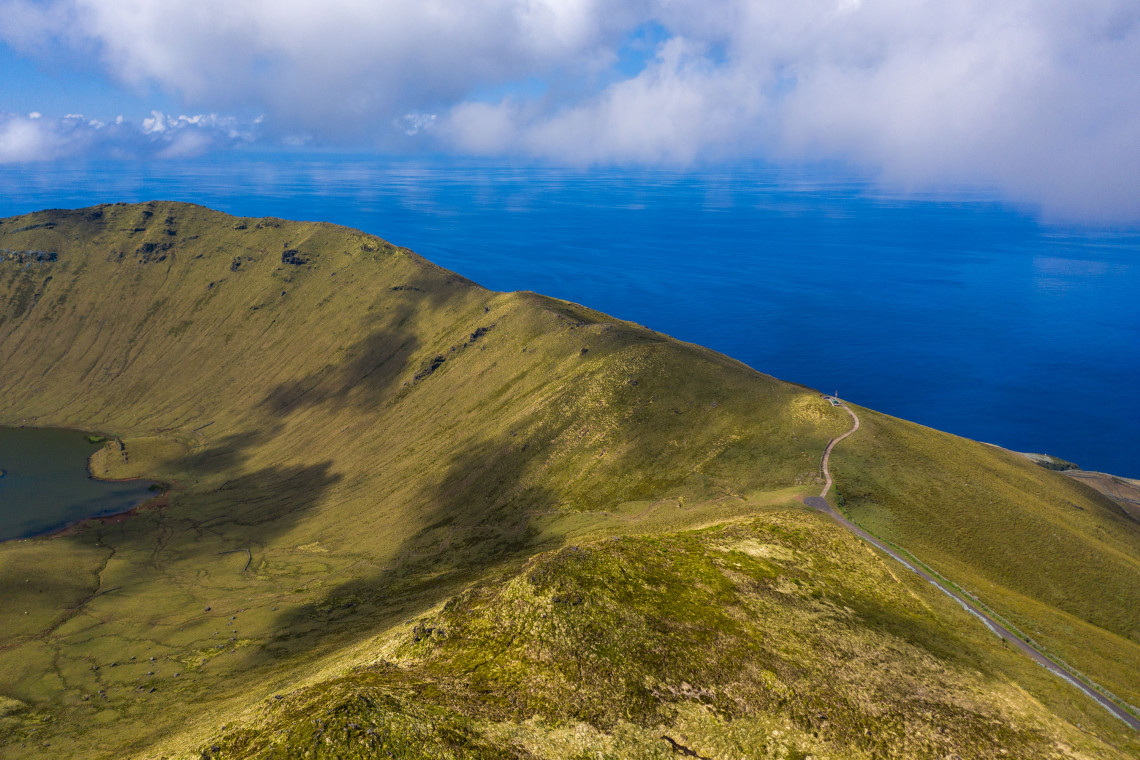
The Caldeirão is the dominant feature of Corvo, and the reason most visitors come. A collapsed volcanic caldera near the island's northern tip, it measures roughly 3.7 kilometers across and drops around 300 meters from rim to crater floor. Two small lakes and a cluster of islets sit inside, surrounded by intensely green pastureland where cows graze in near-silence.
From the Miradouro do Caldeirão viewpoint, the drop is immediate and vertiginous. On a clear day the lakes are visible in full. In fog, the rim can be cloud-covered while the crater floor is clear below, a disorienting inversion that hikers report as one of the stranger experiences in the Azores.
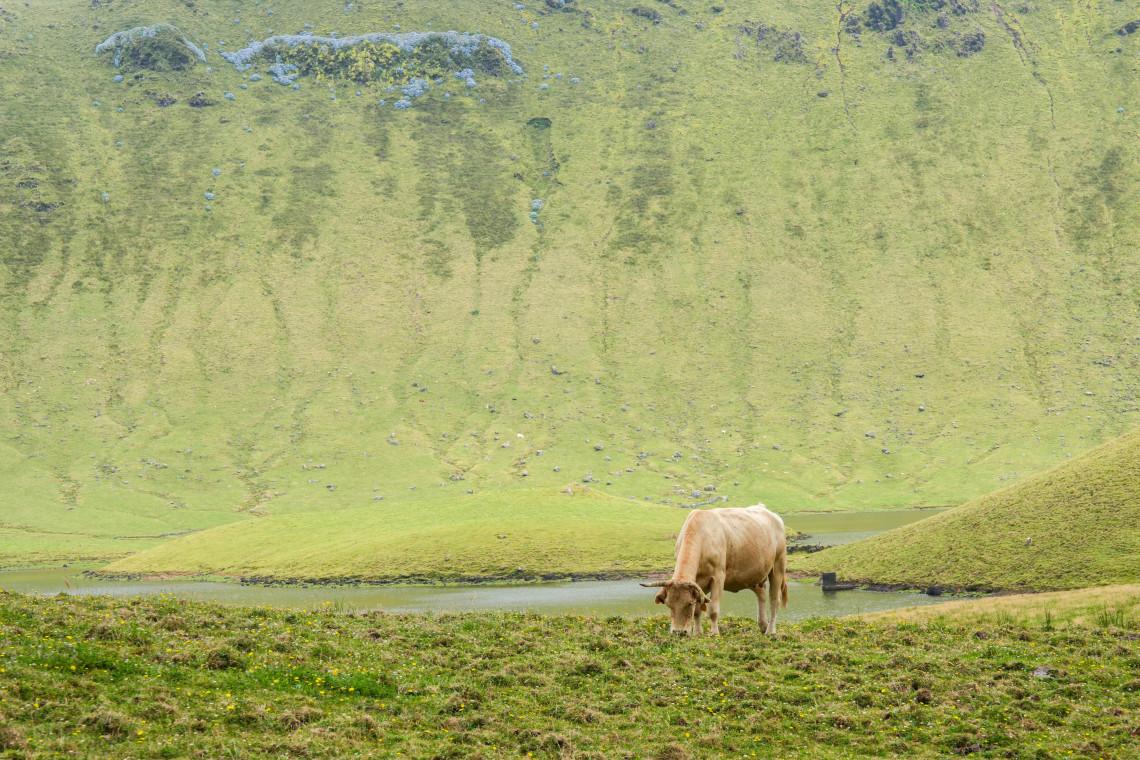
If you can stay overnight: The caldera at sunrise and at sunset is a different place entirely. Day-trip boats from Flores typically depart Corvo around 17h00. After that, the island returns to its 384 permanent residents and the few overnight visitors. The caldera at golden hour, with no other tourists on the rim, is the version most people never see.
A taxi from the village to the caldera viewpoint costs around €5. There are only 7 kilometers of paved road on the entire island.
2. Caldeirão Viewpoint
The viewpoint at the crater rim is the trailhead for both official hiking trails and the natural stopping point for visitors arriving by taxi. The view is the one that appears in every photograph of Corvo: the wide green bowl of the caldera, the glint of the lagoon below, and the Atlantic horizon in the distance.
There is no fence or barrier at the rim in most sections. The edge is genuine.
On good-visibility days, Flores Island is visible across the water to the northeast. The two islands are close enough that the neighboring coastline reads clearly on a clear morning.
3. Vila Nova do Corvo
The island's name means "crow" in Portuguese, a reference to the "marine crows," thought to be American fish crows, that early sailors observed here. Those birds are now extinct in the Azores. The name remained.
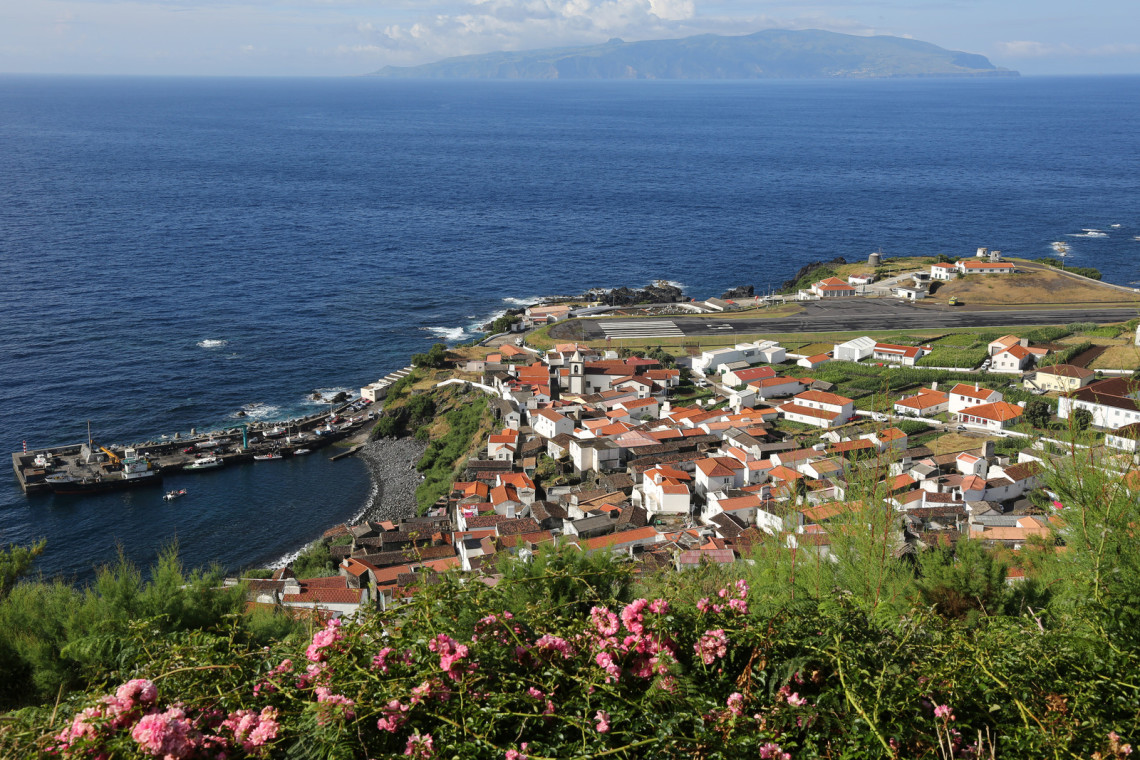
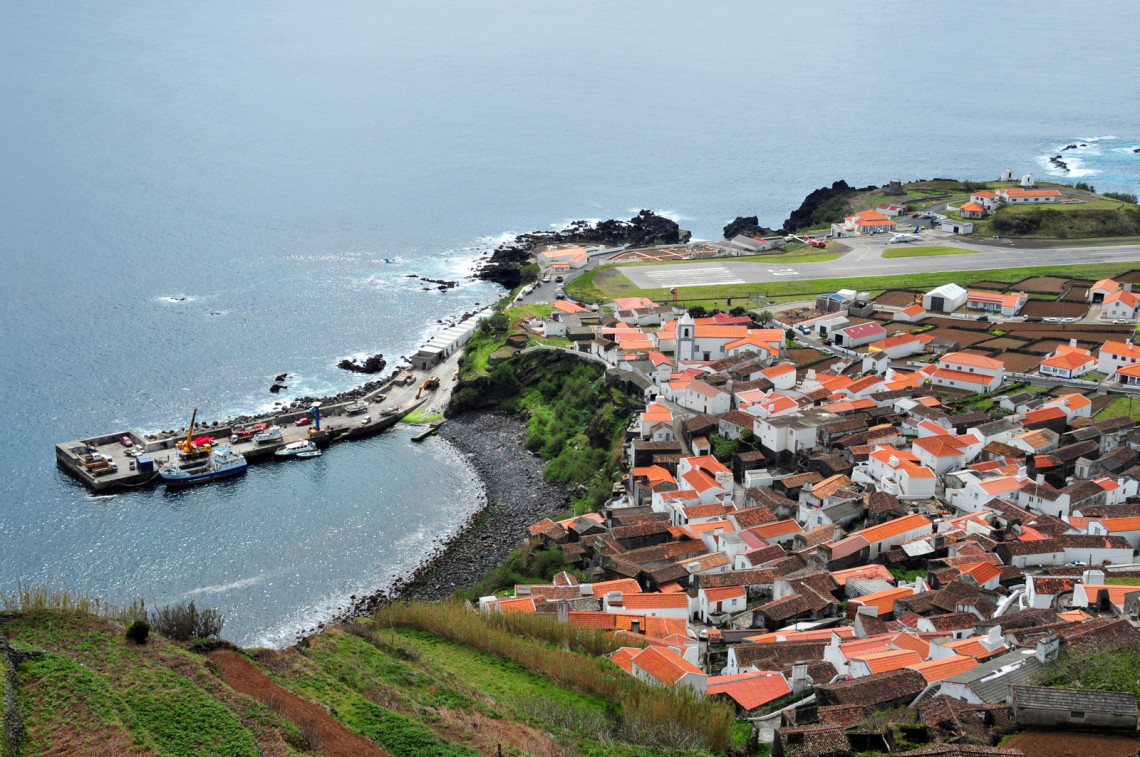
The village itself is the smallest municipality in the Azores and one of the smallest in Europe. Its street plan is compact and old: hand-cobbled lanes, low whitewashed houses, stone walls marking the edges of properties that have been in the same families for generations. The local population, called Corvinos, number around 400.
Walking through the village takes ten minutes end to end. The pace is particular: unhurried in a way that feels less like a tourist attraction performing slowness and more like a place where nothing has required hurrying for a long time.
The Casa do Bote, near the harbor, functions as the tourist information center and is a useful first stop for maps, trail conditions, and local recommendations.
4. Nossa Senhora dos Milagres Church
The church of Our Lady of Miracles sits at the heart of the old village and contains a Flemish sculpture of the Virgin dated to the early 16th century. For a building on a remote Atlantic island, this is a remarkable object: carved wood from Flanders, transported to one of Europe's most isolated communities during the early decades of Portuguese Atlantic exploration.
The story attached to it is worth knowing. Almeidinha was a Portuguese-born American privateer who made stops at the Azores during his Atlantic crossings. On Corvo, he befriended the local priest, known as Padre Queixudo, and paid generously for provisions. He protected the island from other corsairs. When the regional authorities punished the priest for the friendship, Almeidinha gave him a large sum of gold as restitution. The priest converted it into jewelry for the statue of Our Lady of Miracles. The jewels remain with the statue.
The church is the end point of the PR01 COR Cara do Índio hiking trail.
5. Portão Viewpoint
At the upper edge of the village, the Portão viewpoint looks down over the rooftops of Vila do Corvo and, on clear days, across the channel to Flores Island. It is the most accessible viewpoint on the island, walkable from the village in a few minutes, and one of the better spots for early morning photography before the day-trip boats arrive.
From this height, the contrast between the compact geometry of the village below and the open Atlantic beyond it is immediate.
6. Cara do Índio Rock Formation
On the northern coast of the island, a natural formation in the basalt cliff has been worn into a shape that resembles a face in profile. The Corvinos call it the "Cara do Índio" ("Indian Face"). It is visible from the coastal section of the PR01 COR hiking trail and from the dedicated Cabeça do Índio viewpoint.
The rock is not a named landmark in the sense of having official status, but it is one of those details that visitors consistently photograph and remember. The resemblance is clearer from some angles than others.
7. Portinho da Areia and the Windmills
The island's only beach sits at the southern end of Corvo, a short walk from the village. Portinho da Areia (also shown as Praia da Areia on Google Maps) has black volcanic sand, which is relatively uncommon even in the Azores, where most coastline is cliff or pebble. Water temperatures run around 20°C between May and October.
Immediately adjacent to the beach are three restored traditional windmills, originally built for grinding wheat, corn, rye, and barley. They fell out of use after the end of the Salazar dictatorship and were fully restored in 2013. The flat road around the small aerodrome here is one of the only level surfaces on the island, and local residents use it for their daily walks.
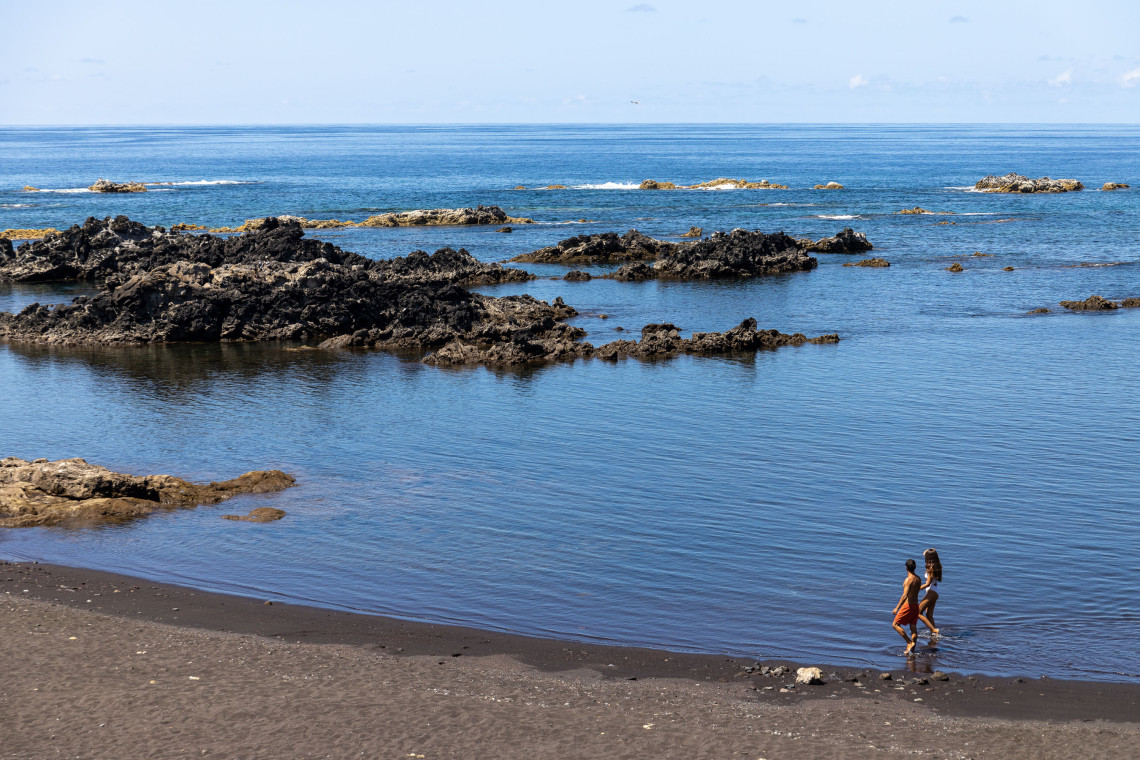
The windmills face west. Sunset from this spot, with the Atlantic behind them, is one of the most photographed views on the island.
A Bordalo II sculpture called "Mero" stands on a boat near the beach: a large-scale animal sculpture made from recycled materials by the Portuguese street artist known internationally for this work. Finding it on an island of 400 people is one of Corvo's more quietly unexpected details.
8. Casa do Tempo (Corvo Ecomuseum)
The Ecomuseum occupies an old stone house in the center of the village and covers the history of the Corvino people across two floors. The ground floor has archival photographs of island life and a short video on Corvo's volcanic origins. The upper floor has a historical timeline and computers loaded with old photographs and genealogical records of local families.
The museum is small and free. The explanations are in English. It is a more affecting place than its modest presentation suggests: the photographs document a community that spent centuries genuinely cut off from the outside world, sometimes for weeks at a time in winter, and adapted to that isolation in ways that are visible in the village's material culture and social structure.
CASA DO TEMPO / ECOMUSEUM
Entrance: Free | Hours: Mon-Fri 9h30-17h00 | Closed weekends
9. Espírito Santo Celebrations (May and June)
If your visit to Corvo falls between May and June, there is a chance you will arrive during the Espírito Santo (Holy Spirit) celebrations, one of the most traditional festive cycles in the Azores. Corvo is among the islands that still observes this practice, and on a community of 400 people, the scale is intimate rather than ceremonial.
The centerpiece is the Espírito Santo soup: a long-cooked broth of beef, bread, and mint, whose ingredients are donated annually by a member of the community. The pot cooks for an entire day and night, and the meal is shared openly with everyone present, residents and visitors alike. The result is a specific flavor that does not appear on any restaurant menu anywhere else.
The celebrations rotate through different dates after Easter across the various islands of the Azores. Check the dates before planning if this is a priority.
10. Monte Gordo
Monte Gordo is the highest point on Corvo Island. It sits above the caldera rim on the northern half of the island and offers unobstructed views in all directions: the Caldeirão below to one side, the Atlantic on every other. On clear days the coastline of Flores is visible to the northeast, and the full scale of Corvo's modest size becomes apparent from up here.
The area around Monte Gordo is within the walking range of the caldera trails. It is not a separate structured route but rather the high ground that frames the caldera landscape. Hikers who reach the rim on the PRC02 COR trail are already near this elevation. The terrain is exposed, so wind is a consistent factor regardless of season, and visibility varies significantly with weather.
This is also a productive area for birdwatching in autumn, when migrants moving along the Atlantic route pass over the high ground.
11. Farolim Canto da Carneira
The Farolim Canto da Carneira is a small lighthouse positioned on the southern coastline of Corvo. Like all lighthouses in the Azores, its function is maritime: marking the island's position and guiding vessels through the stretch of ocean between Corvo and Flores, where currents and weather can be unpredictable.
The lighthouse sits on a low coastal point above the water. It is not a major visitor destination, but its location makes it a natural endpoint for a coastal walk from the village and beach area. The view from this southern tip of the island, looking back toward the village and the caldera plateau above, gives a different perspective on the island's compact geography.
The surrounding cliff vegetation here includes endemic Azorean species adapted to the salt exposure and Atlantic wind.
12. Corvo Wild Birds Interpretation Centre
The Wild Birds Interpretation Centre in Vila do Corvo exists specifically because of the island's reputation among birdwatchers. It displays information and specimens relating to the species that can be found on Corvo throughout the year, with particular attention to the North American vagrant species that arrive during the October migration window.
The displays cover Corvo's resident breeding seabirds (including Cory's Shearwater, Little Shearwater, Roseate Tern, and Common Tern), the migratory species that pass through, and the American vagrants that arrive via Atlantic storm systems. For visitors who arrive without prior knowledge of the island's ornithological significance, this is a useful orientation before heading into the field.
WILD BIRDS INTERPRETATION CENTRE
Entrance: Free | Hours: Mon-Fri 9h00-12h30 and 13h30-17h00 | Closed weekends
Plan Your Corvo Visit with Local Experts
Corvo is best experienced as part of a planned Western Azores itinerary. Our local team handles ferry logistics, accommodation, and island transfers so the timing actually works.