09 September 2026 • 7 min read
Terceira sits on the Azores Triple Junction, where three tectonic plates meet. The volcanic activity that built the island is still going: geothermal gases vent at the surface, the ground is warm in places, and you can walk 90 steps down into a dormant volcanic chimney and stand at the bottom of a chamber 45 meters tall. This guide covers all the main volcanic sites on the island, with practical details for each.
Main sites: Algar do Carvão, Gruta do Natal, Furnas do Enxofre | Season: Algar do Carvão open mid-April to mid-October only | Combined ticket: ~€15
Algar do Carvão
Algar do Carvão is one of only three volcanic chimneys in the world that visitors can walk inside. The lava chimney formed around 3,200 years ago; you descend 90 steps through tunnels and stairs into a domed chamber 45 meters tall and 100 meters wide. The walls are coated in white silica, which gives the interior an otherworldly appearance. Silica stalactites hang from the ceiling, among the largest of their kind anywhere. At the bottom of the chamber there is a small lake, fed by rainwater filtering through the volcanic rock above.

The interior temperature stays at 14°C regardless of the season; bring a layer even in summer. The air is slightly humid and the paths are lit, but the terrain is uneven in places, so proper shoes are necessary.
Entry costs around €6 for adults. Algar do Carvão is open from mid-April to mid-October, Tuesday through Sunday, from 10am. It is closed outside this window; if you are visiting in November through March, plan day two around Furnas do Enxofre and Gruta do Natal instead.

Gruta do Natal
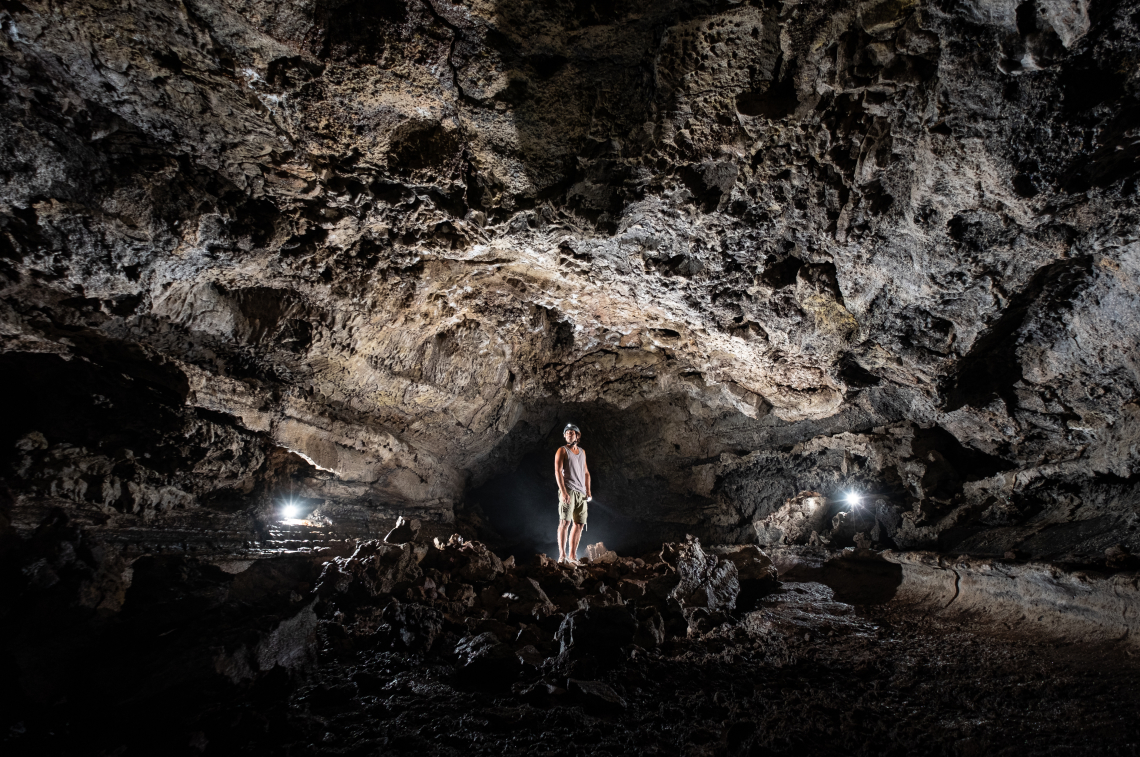
A 700-meter lava tube about five minutes' drive from Algar do Carvão. The name means "Christmas Cave," a reference to the discovery of the cave on Christmas Day in 1969. Unlike Algar do Carvão, which is a vertical chimney, Gruta do Natal is a horizontal tunnel formed by a lava flow that cooled on the outside while the interior kept moving. The result is a smooth-walled passage with Pahoehoe lava textures on the floor and ceiling, small lava stalactites, and formations called lava ropes where the molten rock twisted as it cooled.

The passage is well-lit and the walk is flat and easy. Interpretive signs explain the geology in detail. The visit takes about 45 minutes. Gruta do Natal is open year-round and can be visited independently of Algar do Carvão.
A combined ticket covering both sites costs around €15 per adult and is available at either entrance. If you are only visiting one, Algar do Carvão is the more visually dramatic; if you have time for both, the two together give a more complete picture of what volcanic activity has left behind underground on the island.
Furnas do Enxofre
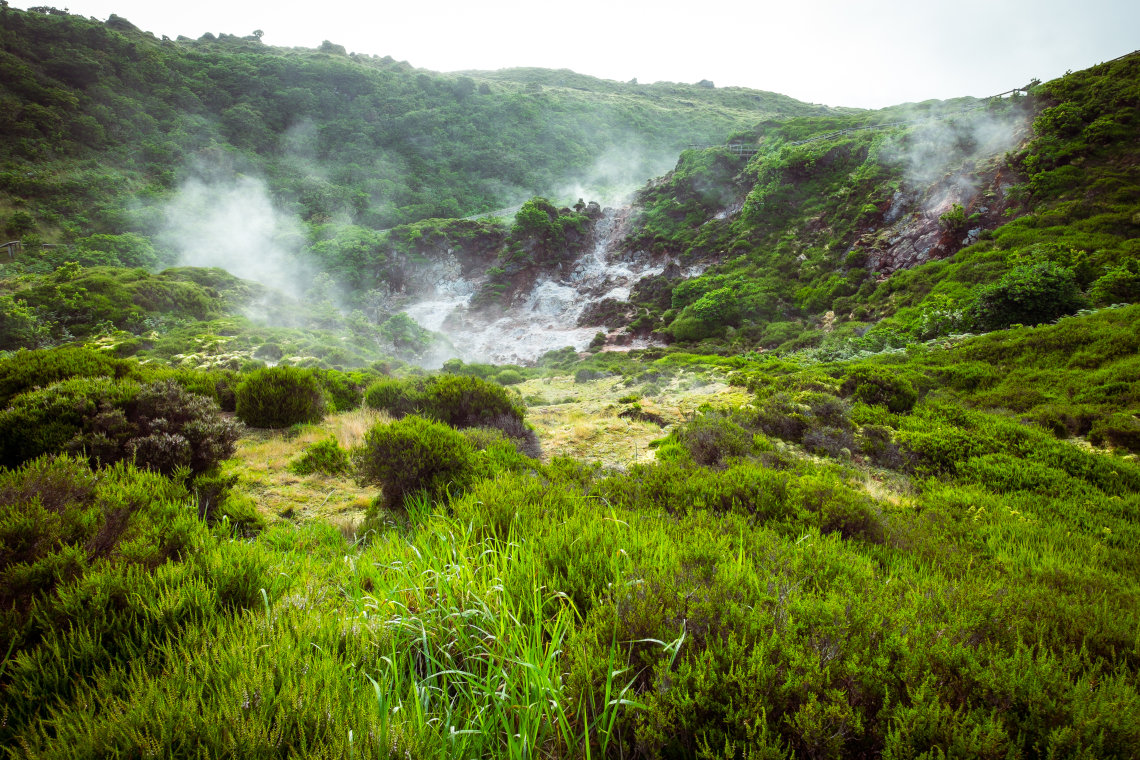
A geothermal field in the volcanic interior of the island, accessible via a wooden boardwalk that loops through cryptomeria and laurel forest. Fumarolic vents release sulfurous gases through fissures in the ground; the smell is strong and the ground is visibly warm in places, with condensation rising from the vents even on dry days. The reddish-orange soil around the vents contrasts with the dense green of the surrounding forest.
Furnas do Enxofre is free to visit and open year-round. The boardwalk takes about 45 minutes to walk at a relaxed pace and is accessible to most visitors. It is the most atmospheric of the three main volcanic sites and the one that most clearly shows the island's ongoing geothermal activity.
GUIDED VOLCANIC TOURS
Four tour options, from a dedicated cave experience to a full-day route combining mountains, fumaroles, and wine.
Serra de Santa Bárbara
The highest point on Terceira at 1,021 meters, Serra de Santa Bárbara sits at the center of the oldest and largest volcanic complex on the island. The caldera below the summit, Caldeira de Guilherme Moniz, is one of the largest calderas in the entire Azores: roughly 15 kilometers in diameter and now filled with dense cryptomeria and laurel forest.
The road to the summit passes through this forest before emerging above the treeline onto exposed moorland. On a clear day, the view from the summit covers most of the island, with the checkerboard pasture of the eastern plateau visible to the east and the Atlantic on all sides. The summit is frequently in cloud; if visibility is low when you arrive, wait 20 minutes before leaving, as the cloud often clears briefly.
Serra de Santa Bárbara is open year-round and free to access. Dress for wind and cold at the summit regardless of the weather below.

Mistérios Negros
A section of black lava fields within the Santa Bárbara Natural Park, accessible by a 4.5km circular trail through cryptomeria forest. The lava flows here are younger than those that formed most of the island; the black basalt has not yet been colonized by soil and vegetation in the same way, giving the landscape a raw, minimal appearance at odds with the green that dominates the rest of Terceira.
The trail passes through the lava field, into the surrounding forest, and back out again. It is rated moderate, takes about two hours, and requires appropriate footwear as the lava surface is uneven. Trailhead is accessible by car; coordinates for parking are easily found via Google Maps by searching "Mistérios Negros Terceira."

Caldeira de Guilherme Moniz
The caldera itself, the collapsed crater of the ancient Serra de Santa Bárbara volcano, is not a viewpoint or a visitor site in the conventional sense: it is a broad, forested depression in the center of the island that you drive across rather than look into. Roads cross it between the interior villages, passing through the dense cryptomeria plantations that now fill the caldera floor. The geology is most legible from the Serra de Santa Bárbara summit above, where the scale of the depression becomes clear.

Practical Notes
Combining the sites: The three main sites (Algar do Carvão, Gruta do Natal, Furnas do Enxofre) are within 10 minutes of each other by car in the volcanic interior. A morning leaving Angra by 9am is enough to visit all three before lunch. Serra de Santa Bárbara and Mistérios Negros are in the western part of the island and work better as an afternoon addition or a separate half-day.
Opening times: Algar do Carvão is open mid-April to mid-October, Tuesday to Sunday, from 10am. Gruta do Natal and Furnas do Enxofre are open year-round. Serra de Santa Bárbara and Mistérios Negros have no admission or formal hours.
What to wear: 14°C inside Algar do Carvão regardless of outside temperature; bring a layer. Sturdy shoes for both caves and the Mistérios Negros trail. Wind protection for Serra de Santa Bárbara summit.
Guided vs. self-guided: The three underground sites are manageable without a guide, as all have good signage. A guided van or small group tour adds geological context that makes the visit more informative, particularly for the less obvious features of Furnas do Enxofre. Tours typically run three to four hours and combine all three sites in one morning.
✨ PREFER A CUSTOM TRIP?
Our travel advisors can build a Terceira itinerary around the volcanic sites, with guided tours, transport, and hotels arranged in advance.
Plan a Tailor Made Trip →Keep reading
Frequently Asked Questions
Can you walk inside a volcano on Terceira Island?
Yes. Algar do Carvão is a dormant volcanic chimney you can descend on foot: 90 steps down into a chamber 45 meters tall, with silica-white walls and a small lake at the bottom. It is one of only three volcanic chimneys in the world open to visitors. Entry is around €6; the site is open mid-April to mid-October, Tuesday through Sunday.
What is the difference between Algar do Carvão and Gruta do Natal?
Algar do Carvão is a vertical volcanic chimney; you descend into the crater of a dormant volcano. Gruta do Natal is a horizontal lava tube, a tunnel formed by a lava flow that cooled on the outside while the interior kept moving. Both are in the same area and take about 45 minutes to visit each. A combined ticket covers both for around €15.
Is Furnas do Enxofre worth visiting?
Yes. The geothermal field has active fumarolic vents, sulfurous gases, and orange-stained ground set against dense laurel and cryptomeria forest. It is free to visit, open year-round, and about 45 minutes on the boardwalk. It is less dramatic than Algar do Carvão but more immediately alive: the gases are visible, the ground is warm, and the landscape has a quality you do not find anywhere else on the island.
When is Algar do Carvão open?
Mid-April to mid-October, Tuesday through Sunday, from 10am. It is closed in winter. If you are visiting outside this window, Gruta do Natal and Furnas do Enxofre are both open year-round and free.
Are there guided tours to the volcanic sites on Terceira?
Yes. Two options are available through Azores Getaways: a van tour where you buy your own site tickets, and a small group excursion with tickets included. Both visit Algar do Carvão, Gruta do Natal, and Furnas do Enxofre in one morning. A guided tour adds geological context that the on-site signs alone do not fully provide.
.jpg "Jeep tour through Cumeeiras, Sete Cidades, São Miguel Island")
.jpg "Sete Cidades Caldera Lakes in São Miguel Island, Azores")