October 2026 • 12 min read
The Azores are nine Portuguese islands in the middle of the North Atlantic, about 1,400 km west of Lisbon and 4,000 km east of Boston, reached by direct flights of two and a half hours from Lisbon or Porto and five to six hours from Boston, New York or Toronto. They are part of Portugal and the EU, use the euro, speak Portuguese (English is widely spoken in tourism) and sit one hour behind Lisbon. The islands are volcanic, green and mild all year, with crater lakes, hot springs, whales offshore and almost no mass tourism. Most first-time visitors spend five to seven days on São Miguel, or split a week between São Miguel and one more island, and rent a car.
This is the starting page. Each section below answers one of the questions first-time visitors ask us, and links to the detailed guide when you need more.
Where Are the Azores?
The Azores (Açores in Portuguese) are an archipelago of nine islands in the North Atlantic Ocean, between roughly 37° and 40° north and 25° and 31° west, which puts them on about the same latitude as Lisbon, Washington DC and Beijing. They lie around 1,400 km west of mainland Portugal, 1,900 km south-east of Newfoundland and about 4,000 km from Boston, which makes them the closest piece of Europe to North America and explains why the first European settlement in the islands dates from the 1430s and why so many Azoreans emigrated to New England, Ontario and California.

They are an Autonomous Region of Portugal, with their own government and parliament since 1976, and therefore part of the European Union and the Schengen area: an EU, UK, US or Canadian passport holder enters on the same terms as for Lisbon, with no extra visa for stays under 90 days. The islands stretch 600 km from east to west and fall into three groups. The Eastern Group holds São Miguel, the largest island and home to the main airport and the largest city, Ponta Delgada, and Santa Maria. The Central Group has Terceira, with the UNESCO-listed city of Angra do Heroísmo, Pico with Portugal's highest mountain (2,351 m), Faial, São Jorge and Graciosa. The Western Group, Flores and Corvo, is the most remote, the wettest and the greenest. In total the archipelago covers 2,351 km² and has about 237,000 inhabitants, more than half of them on São Miguel.

The time zone is UTC minus one hour, one hour behind Lisbon and London and four hours ahead of New York, with daylight saving in summer. The currency is the euro, the language is Portuguese, and English is spoken in hotels, restaurants and by every tour operator, less so in village shops.
What Are the Azores Like?
The islands are volcanic, and everything that makes them special comes from that: crater lakes such as Sete Cidades and Lagoa do Fogo on São Miguel, the hot springs and geothermal cooking of Furnas, the cone of Pico rising straight out of the sea, the lava fields and vineyards of Pico and Terceira, the fajãs of São Jorge, the caldeira of Faial and the still-steaming volcano at Capelinhos that erupted in 1957. The climate is mild oceanic: around 17°C in winter and 25°C in summer by day, never frost at sea level and never a heatwave, with rain spread through the year and heaviest from October to February. The result is a green landscape of pastures, hydrangea hedges and laurel forest that looks more like Ireland or New Zealand than southern Europe.
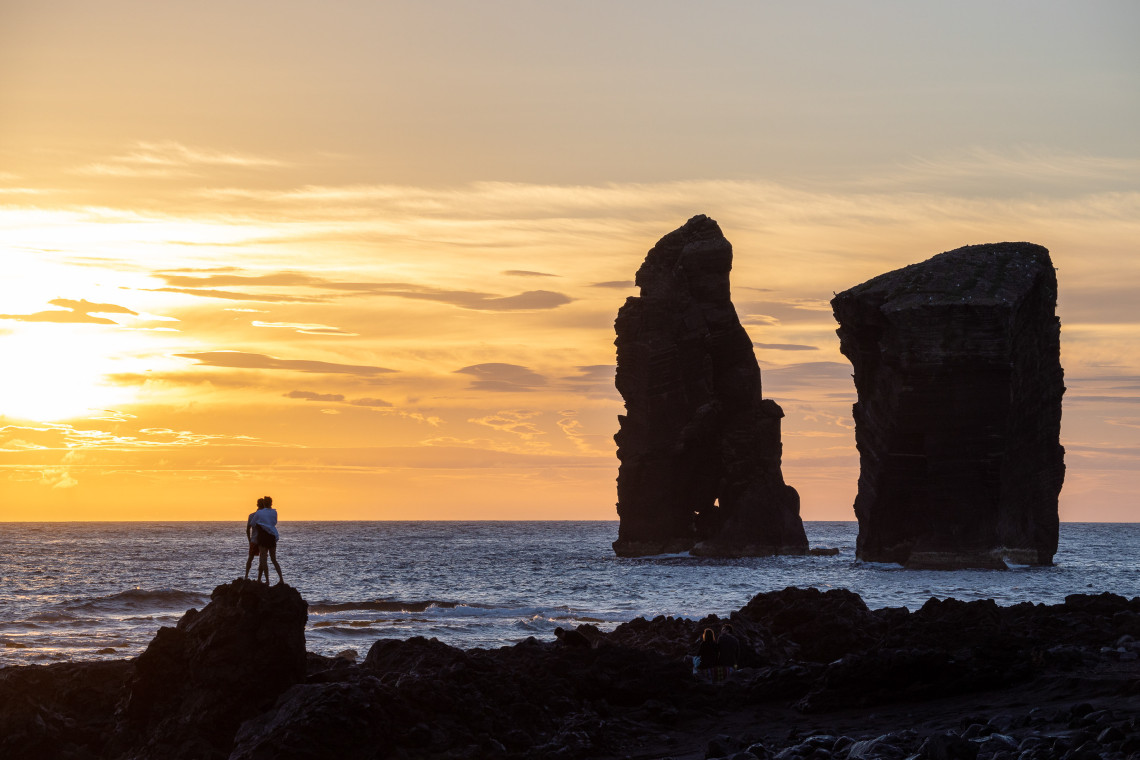
Life on the islands is rural and quiet. Cattle outnumber people, villages are built around whitewashed churches and the small chapels of the Holy Spirit festivals, fish comes off the boat in the morning and the food is honest and generous. Tourism has grown fast since low-cost flights arrived in 2015, but by the standards of the Mediterranean it remains small: no high-rise hotels, no beach clubs, few crowds outside a handful of viewpoints in August. The Azores are a nature destination for people who want to hike, swim in hot springs and natural pools, watch whales, eat well and drive quiet roads. They are not a destination for beach holidays in the Caribbean sense, for nightlife or for guaranteed sunshine.
How Do You Get to the Azores?
By air, almost always via Ponta Delgada (PDL) on São Miguel, the main international airport; Terceira (TER) and, seasonally, Horta on Faial and Pico also receive flights from outside the islands. From mainland Portugal there are many daily flights from Lisbon and Porto with TAP, Azores Airlines and Ryanair, taking about two and a half hours; Ryanair's arrival in 2015 is what opened the islands to the rest of Europe. From elsewhere in Europe there are direct flights from London, Frankfurt, Paris, Amsterdam and several other cities, mostly from spring to autumn, taking four to four and a half hours. From North America, Azores Airlines flies non-stop from Boston all year and from New York, Toronto and Montreal, with United also serving New York in summer; flight time is five to six hours, which makes the Azores the shortest transatlantic hop from the US East Coast.

There is no passenger ferry to the Azores from the mainland or from Madeira. Within the islands, SATA Air Açores flies between all nine, and Atlânticoline ferries connect Faial, Pico and São Jorge all year and the other islands seasonally. Our guides to inter-island flights and ferries cover the routes.
Which Island Should You Visit?
For a first trip, São Miguel. It has the main airport, the widest choice of hotels and restaurants, the hot springs of Furnas, the crater lakes, whale watching from Ponta Delgada, the tea plantations and the only real town, and it rewards five to seven days on its own. If you have a week or more, add a second island by a short SATA flight: Terceira for history, festivals and the easiest second island logistically; Pico for the mountain, the UNESCO vineyards and the best whale watching; Faial and São Jorge, reached from Pico by ferry, for the Capelinhos volcano and the fajãs; Flores for waterfalls and solitude if you have the time and tolerance for weather. Santa Maria is the beach and diving island, best as a two-night add-on. Our guide to which Azores island to visit first compares all nine.
How Many Days Do You Need?
Five days is the minimum for São Miguel without rushing; seven lets you add a second island or slow down. Ten to fourteen days covers three or four islands with the inter-island flights and ferries in between, which is the trip most people who return for a second time end up planning. Weekend trips from Lisbon are possible but see only a corner of São Miguel. The detailed answer, with sample itineraries by length, is in our guide to how many days are enough for the Azores.
AZORES VACATION PACKAGES
Flights, hotels and rental car bundled by island-born travel advisors, for one island or several, with the inter-island connections handled for you.
See all packages →What Is There to Do?
The short list, in the order most first-time visitors rank them afterwards: the crater lakes of Sete Cidades and Lagoa do Fogo; a soak in the hot springs of Furnas, Caldeira Velha or the ocean pool at Ferraria; whale and dolphin watching, with sperm whales resident all year and blue whales passing in April and May; hiking, with hundreds of kilometres of waymarked trails on every island; the Gorreana tea plantation, the only commercial one in Europe; a cozido lifted from the volcanic ground at Furnas and the São Jorge cheese and Pico wine that go with it; climbing Pico, the highest mountain in Portugal; and the natural swimming pools cut into the lava around every coast. Our guide to the top experiences in the Azores ranks fifteen of them by island.

WHALE WATCHING FROM PONTA DELGADA
Half-day trip by catamaran with marine biologists, the single most booked experience on São Miguel. Runs all year, best from April to September.
Book whale watching →When Is the Best Time to Go?
May to early October for weather, with June and September the best balance of warmth, dry days, swimmable sea and moderate crowds. July and August are the warmest, driest and busiest months, with the highest prices and the hydrangeas in bloom. April and May are the whale months. November to March is mild, green, wet and cheap, and suits a hot-springs and food trip rather than a hiking one. Our month-by-month guide to the best time to visit the Azores has the figures.

How Do You Get Around?
Rent a car. On every island except Corvo the sights are spread along the coasts and up in the craters, buses are infrequent and built for residents, and ride-hailing exists only in Ponta Delgada and Angra with a handful of cars. A small manual car costs roughly 25 to 50 euros a day depending on season; automatics cost more and sell out first in summer, so book with your flights. Roads are narrow, winding and well surfaced, traffic is light and there are no tolls. The alternative is to base yourself in Ponta Delgada or Angra and book full-day guided tours with hotel pick-up. Our guide on whether you need a car in the Azores goes island by island.

Where Do You Stay?
The Azores have no resort strips. Accommodation is a mix of city hotels in Ponta Delgada and Angra, a few four- and five-star hotels with spas (Furnas has the best known), rural tourism houses and quintas in the countryside, and a growing number of holiday homes. On São Miguel most visitors split time between Ponta Delgada, for restaurants and tours, and Furnas, for the hot springs; on the other islands you stay in or near the main town. Book early for July, August and the Christmas week; outside those, a few weeks ahead is enough.

How Much Does It Cost?
Less than most of Western Europe and far less than the Mediterranean islands in summer. As a rough guide for 2026: a mid-range double room 90 to 150 euros a night, with Furnas spa hotels and Ponta Delgada's best addresses above that; a small rental car 25 to 50 euros a day; a grilled fish or steak main in a local restaurant 10 to 18 euros; a coffee about 1 euro and a local beer 1.50 to 2 euros; entry to the Terra Nostra thermal garden or Caldeira Velha under 10 euros; a whale-watching trip 55 to 75 euros; a cozido lunch in Furnas 20 to 25 euros. Two people travelling comfortably for a week on São Miguel, with flights from Lisbon, a car and a mid-range hotel, should budget around 1,800 to 2,500 euros all in, and considerably less in the shoulder months. Our detailed cost guide from the US and Canada breaks down flights and packages.

Are the Azores Safe?
Yes. Portugal ranks among the safest countries in the world and the Azores are its quietest corner: violent crime is rare, petty theft is uncommon even in Ponta Delgada, and you can leave the car at a trailhead without worry. The risks are natural rather than human: changeable weather on the high trails, swell at the natural pools, steep roads in fog, and the sun, which is stronger than the mild temperatures suggest. Tap water is safe, healthcare is good on São Miguel and Terceira and basic on the smaller islands, and the EU emergency number 112 works everywhere. Travel insurance is sensible mainly for flight disruption, because weather can delay inter-island connections.

Practical Essentials
Electricity is 230 V with European two-pin plugs, so North American visitors need an adapter. Mobile coverage is good in towns and patchy in the interior and on the smaller islands; EU roaming applies to EU SIMs. Cards are accepted almost everywhere, with cash useful at village cafés and festivals. Shops close on Sunday afternoons and many restaurants close between lunch and dinner. Tipping is modest: rounding up or 5 to 10 percent for good service. The islands are on Portuguese time for meals, with lunch from 12:30 and dinner from 7:30 pm. Pack layers and a rain shell in any month, swimwear for the hot springs, and shoes with grip.

Plan the details
Plan it your way
Custom Your Trip
Tell our local travel advisors which islands, dates and experiences you want and we build the itinerary around you.
Start your custom trip →Limited time
Azores Packages On Sale
Flights, hotels and rental car bundled at reduced prices. See every package currently on sale and book while it lasts.
Book now →Azores Travel Guide: FAQ
Where are the Azores located?
In the North Atlantic Ocean, about 1,400 km west of Lisbon and 4,000 km east of Boston, between 37° and 40° north. They are an autonomous region of Portugal, part of the EU and Schengen, spread over 600 km in three groups of islands.
What country do the Azores belong to?
Portugal. The nine islands have been Portuguese since their settlement in the 15th century and have been an Autonomous Region with their own government since 1976. The currency is the euro and the language Portuguese.
Are the Azores worth visiting?
Yes, for travellers who want nature, hiking, hot springs, whales, food and quiet rather than beaches and nightlife. They are mild all year, uncrowded by European standards, cheaper than most of Western Europe and five hours from the US East Coast.
How do you get to the Azores?
Fly to Ponta Delgada on São Miguel: two and a half hours from Lisbon or Porto with TAP, Azores Airlines or Ryanair, four to four and a half hours from London, Frankfurt, Paris or Amsterdam, and five to six hours non-stop from Boston, New York, Toronto or Montreal with Azores Airlines. There is no ferry from the mainland.
Which Azores island is best for a first visit?
São Miguel. It has the main airport, the most hotels and restaurants, the hot springs of Furnas, the crater lakes, whale watching and the tea plantations, and it fills five to seven days. Add Terceira or Pico if you have more time.
How many days do you need in the Azores?
Five for São Miguel, seven to add a second island, ten to fourteen for three or four islands.
What language do they speak in the Azores?
Portuguese. English is spoken widely in hotels, restaurants and by tour operators, and many Azoreans have family in the US or Canada and speak it fluently.
What is the weather like in the Azores?
Mild oceanic all year: about 17°C by day in winter and 25°C in summer, with rain spread through the year and heaviest from October to February, and fast-changing skies. July is the driest month, June and September the best balance of warmth and quiet.
Are the Azores expensive?
No. A mid-range hotel is 90 to 150 euros a night, a restaurant main 10 to 18 euros, a small rental car 25 to 50 euros a day. Two people can do a comfortable week on São Miguel for roughly 1,800 to 2,500 euros including flights from Lisbon. Prices peak in July and August.
Do I need a visa for the Azores?
The same rules as mainland Portugal apply: EU citizens need only an ID card, and UK, US, Canadian and most other visitors can stay up to 90 days in the Schengen area without a visa, subject to the EU's entry requirements in force at the time of travel.
Is it safe to travel to the Azores?
Very. Crime is rare, tap water is safe and healthcare is good on the main islands. The practical risks are weather on the trails, swell at the natural pools and fog on the mountain roads.